

What if a supplier’s product sheet looks right, but the oil, quality documents, or shipment setup don’t fit your operation? Choosing a refined sunflower oil wholesale supplier means checking more than a quoted specification. Buyers need to confirm that the product suits their production requirements, documents can be reviewed, and packaging and contract terms work for the destination and receiving facilities.
A repeatable sourcing checklist makes those checks easier. This guide explains how to compare specifications, review supplier controls and certification documents, and assess packaging and export readiness before committing. It also outlines practical questions to ask about flexitanks, IBCs, drums, and FOB or CIF terms. For buyers considering a Thailand-based B2B export option, reported certifications are a starting point for verification, not a substitute for checking validity, facility scope, and product coverage. Use this framework to qualify suppliers consistently and shortlist one whose product, documentation, and shipment plan match your requirements.
Key Takeaways
- Compare the supplier’s current product specification with your production requirements before moving toward a contract.
- Review quality records, certification details, and pre-shipment documentation in a consistent sequence.
- Assess a refined sunflower oil wholesale supplier on verifiable capabilities, not broad marketing claims or unsupported assurances.
- Match flexitanks, IBCs, or industrial drums to your receiving setup, and confirm availability and loading details for the shipment.
- Shortlist suppliers by checking product requirements, documents, packaging, and FOB Thailand or CIF terms against your destination needs.
What should a refined sunflower oil wholesale supplier provide?
A qualified refined sunflower oil wholesale supplier provides the agreed product and verifiable documents so a buyer can assess quality and shipment details before committing. Ask for a current product specification, confirm which supporting quality and shipment records are available, and check that the proposed packaging and contract terms suit your destination and receiving setup.
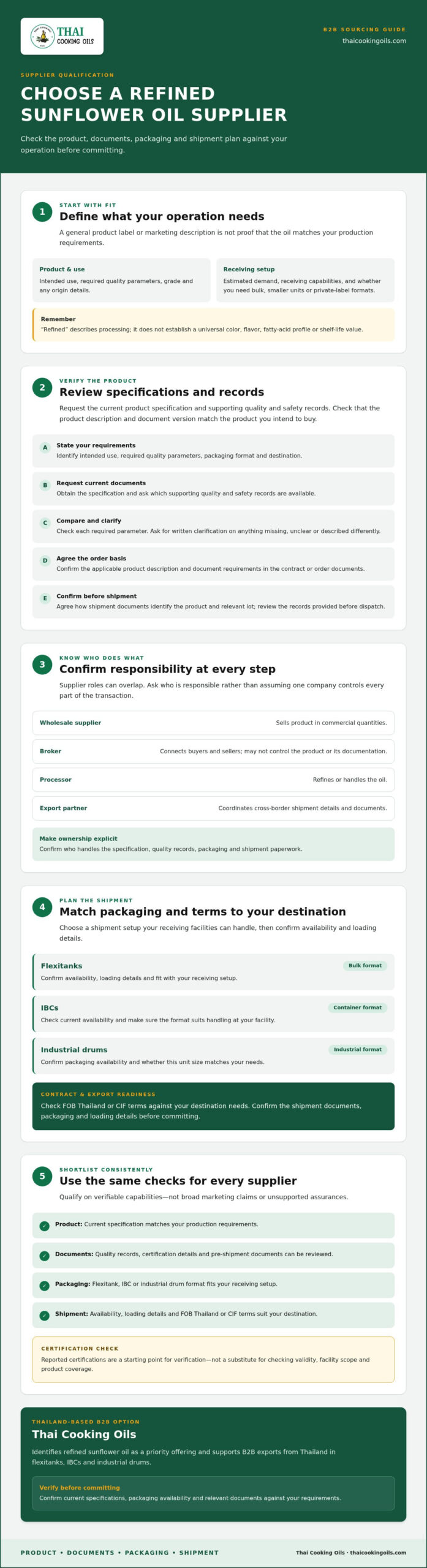
Supplier roles can overlap, but the distinctions matter. A wholesale supplier sells product in commercial quantities. A broker connects buyers and sellers and may not control the product or its documentation. A processor refines or handles the oil. An export partner coordinates cross-border shipment details and documents. Ask who is responsible for the product specification, quality records, packaging, and shipment paperwork rather than assuming one company controls every step.
Which buyers source refined sunflower oil in bulk?
Food manufacturers may purchase oil as an ingredient or for production processes. Distributors source it for onward supply to business customers, while restaurant supply channels serve commercial kitchens. Retail-ready private-label purchases have additional packaging and branding requirements, so they need a separate discussion alongside the product and shipment details.
Before requesting an offer, define your intended use, estimated demand, and receiving capabilities. Clarify whether your facility can handle bulk deliveries or needs smaller units, and whether you require industrial packaging or private-label formats. These details help suppliers assess fit more effectively than a general volume inquiry.
What does “refined” mean for procurement?
“Refined” describes processing, not a complete purchasing specification. It doesn’t establish a universal color, flavor, fatty-acid profile, or shelf-life value. Sunflower oil types and composition can vary; see this overview of Sunflower oil composition and types for general background.
Request the supplier’s current product specification and supporting documents, then compare them with your process, quality criteria, and destination requirements. Confirm any required grade, origin details, and shipment records directly with the supplier. Don’t treat a product label or general marketing description as proof that the oil meets your production needs.
Thai Cooking Oils identifies refined sunflower oil as a priority offering and supports B2B exports from Thailand in flexitanks, IBCs, and industrial drums. Confirm current specifications, packaging availability, and relevant documents against your requirements before committing to a contract.
How to verify sunflower oil specifications and quality documents
Review product documents against your intended use, production process, and destination-market requirements. A specification that suits one buyer may not suit another. Before committing to a contract, resolve gaps in writing and agree which documents will apply to the order and shipment.
What should a sunflower oil specification sheet contain?
Ask the refined sunflower oil wholesale supplier for its current specification and supporting records. Check that the product description and document version match the product you intend to purchase. Depending on your requirements, review product identity, quality and safety parameters, packaging information, and storage guidance. Don’t assume a general product description is a complete specification.
Use this workflow to move from initial review to shipment confirmation:
- 1. State your requirements. Identify the intended use, required quality parameters, packaging format, and destination.
- 2. Request current documents. Obtain the product specification and ask which supporting quality and safety records are available.
- 3. Compare and clarify. Check each required parameter against the supplier’s stated information. Mark missing, unclear, or differently described items for written clarification.
- 4. Agree the order basis. Confirm the applicable product description and document requirements in the contract or order documentation.
- 5. Confirm before shipment. Agree how the shipment documents will identify the product and relevant lot, then review the records provided before dispatch.
For U.S. government export-program transactions, the USDA export requirements for sunflower oil may provide a relevant reference. Check that the document applies to your specific program and transaction. It does not replace a destination-specific review.
How should buyers review a certificate of analysis?
A certificate of analysis (COA) supports review of reported test results for a stated product or lot. Check the product identification, batch or lot reference, issue date, reported results, and issuing laboratory or party. If traceability is unclear, request an explanation or supporting information before relying on the document.
Compare the COA results with the agreed specification, not assumed industry values. A sample or certificate doesn’t automatically establish that every shipment will match it. Ask how the document relates to the order and confirm what lot-specific evidence will be provided before shipment.
Check certificate scope and validity before relying on a quality document. For reported supplier certifications, verify current validity, issuing body, facility scope, and product coverage. Buyers considering Thailand-based Thai Cooking Oils can review refined sunflower oil supply information and request current specifications and supporting documents for assessment.
How to compare refined sunflower oil wholesale suppliers
Compare suppliers against the same buying criteria. A consistent review helps distinguish documented capabilities from broad marketing language and shows where further checks are needed. Assess what you can verify, not what a supplier simply claims.
| Area | What to compare | Evidence or question |
|---|---|---|
| Specifications | Fit with your required product parameters and intended use | Does the current specification match your requirements, and are unclear items answered in writing? |
| Documentation | Quality records and applicable certificates | Can the supplier identify the issuer, validity, facility, and scope for each document? |
| Packaging | Suitability for your receiving and handling setup | Can the supplier confirm current availability, compatibility, and loading details for the proposed format? |
| Communication | Clarity and responsiveness on technical and logistics questions | Are answers specific, consistent, and supported by documents where appropriate? |
| Contract terms | Responsibilities and shipment basis | Are the product, packaging, documents, and agreed FOB or CIF terms clearly stated? |
Which quality and certification checks matter?
Ask for current copies of relevant certificates and verify the issuing body, validity dates, facility, and applicable scope. Thai Cooking Oils reports ISO 22000, HACCP, GMP, Halal, Kosher, and FSSC 22000 certifications. Treat these reported credentials as a starting point for review, not proof that every certificate covers the product, facility, or destination in your transaction.
A certificate claim is not the same as verified certificate scope. Confirm the details directly, then check destination-specific requirements independently. Certification can support supplier evaluation, but it doesn’t replace document review or your own compliance checks.
How can procurement teams assess supply reliability?
Ask how the supplier sources or produces the oil, controls document versions, and communicates order updates. You’re assessing whether the process is clear, not seeking unsupported assurances about uninterrupted supply. Ask what happens if a specification, packaging choice, or shipment plan changes, and how revised details will be confirmed.
A capable refined sunflower oil wholesale supplier should answer technical and logistics questions with relevant information, identify what still needs confirmation, and clarify who is responsible for each document or shipment detail. Compare these answers across shortlisted suppliers before advancing negotiations.
How to align bulk packaging and export terms with your operation
Packaging and contract terms need to work with the destination, receiving site, and downstream handling plan. Before confirming an order, identify the destination port, importer responsibilities, required shipment documents, and equipment available at the receiving facility. Then ask the refined sunflower oil wholesale supplier to confirm that the proposed format and shipment arrangement are available for your order.
Which bulk packaging format fits the receiving site?
There’s no universal best format. Compare each option with your unloading equipment, storage capacity, handling procedures, and onward distribution needs. A format that suits a facility set up for bulk transfer may not fit a site that handles containers individually.
- Flexitanks: Check whether the receiving site can manage the proposed bulk loading and discharge arrangement.
- IBCs: Check storage space, handling equipment, and how units move through your operation.
- Industrial drums: Consider manual or mechanical handling, storage, and the process for transferring oil into production or distribution.
Request written confirmation of packaging availability, materials, compatibility, loading configuration, and handling instructions. Confirm loading details with the supplier rather than relying on typical figures. Thai Cooking Oils supports bulk shipments in flexitanks, IBCs, and industrial drums, but buyers should verify current configurations and suitability for their receiving setup.
What should buyers confirm in FOB or CIF discussions?
Thai Cooking Oils offers FOB Thailand and CIF global-port contract terms. At a high level, FOB and CIF describe different shipment arrangements. The contract should identify the agreed named port and clearly state each party’s responsibilities. Confirm freight and insurance arrangements, applicable shipment documents, and the importer’s role before accepting the terms.
Review the proposed arrangement with relevant trade professionals, especially when destination requirements or importer responsibilities need clarification. Check that the agreed product, packaging, port, and documents are consistent across the purchase contract and shipment paperwork. Keep the order discussion focused on your specific shipment rather than assumptions about what a trade term includes.
For a practical review, prepare a checklist covering receiving equipment, selected packaging, destination port, contract basis, shipment documents, and importer responsibilities. Resolve open items in writing before confirming the order. Discuss your bulk sunflower oil requirements with Thai Cooking Oils to assess packaging and FOB Thailand or CIF options for your shipment.
How to shortlist a refined sunflower oil wholesale supplier in Thailand
Supplier qualification comes down to alignment across three areas: product, documentation, and logistics. A supplier should match your required specification, provide documents you can review, and confirm packaging and contract terms that fit your destination and receiving operation. Use the same sequence for every candidate to keep comparisons objective.
- Specify your needs. Define the intended use, product requirements, estimated volume, and receiving constraints.
- Request documents. Ask for the current product specification and relevant quality, safety, and shipment documents. Check what each document covers.
- Confirm terms. Clarify packaging, destination port, preferred FOB or CIF basis, and responsibilities for shipment documentation.
- Assess fit. Compare the supplier’s written responses with your requirements. Resolve unanswered questions before committing to a contract.
What information should buyers include in an inquiry?
A focused inquiry gives a supplier the details needed to assess your request. Include the destination country and port, intended application, and required product specification. State the expected volume, preferred packaging, and receiving-site limitations, such as available unloading or storage arrangements.
Also identify the certificates and quality or shipment documents you need, along with your preferred FOB or CIF basis. If you’re still evaluating a requirement, say so. That makes open items visible instead of allowing assumptions to carry into negotiations.
What can Thai Cooking Oils support?
Thai Cooking Oils exports refined sunflower oil from Thailand to international B2B buyers. Its stated capabilities include bulk shipments in flexitanks, IBCs, and industrial drums, as well as private-label packaging services. FOB Thailand and CIF global-port contract terms are also offered. These capabilities are a starting point for assessing potential fit, not confirmation that every specification or configuration is available for a particular order.
Ask the company to confirm current product details, certificate validity and scope, destination-specific documents, packaging configuration, and shipment terms for your requirements. Verify responses against your own quality review and import process. The information you receive should clarify what is confirmed, what remains subject to review, and who is responsible for each order detail.
Prepare your inquiry with the destination, intended use, specification, volume, packaging preference, receiving constraints, required documents, and trade term. Then ask Thai Cooking Oils to review whether its refined sunflower oil export capabilities align with your procurement needs.
Make your shortlist with confidence
A strong supplier decision rests on fit, not claims alone. Compare each refined sunflower oil wholesale supplier against your product requirements, reviewable quality documents, and destination-specific shipment needs. Confirm unresolved details in writing before committing to a contract.
Thai Cooking Oils is a Thailand-based B2B exporter with refined sunflower oil as a priority offering. Its stated capabilities include bulk shipments in flexitanks, IBCs, and industrial drums, plus FOB Thailand or CIF terms. The company also reports international quality and food-safety certifications, including ISO 22000, HACCP, GMP, Halal, Kosher, and FSSC 22000. Verify current certificate validity and scope, along with the specifications and shipment configuration relevant to your order.
Prepare your intended use, destination, volume, specification, packaging preference, and preferred trade term for a focused supply discussion. Request a refined sunflower oil supply discussion and assess whether the documented product and export arrangements fit your procurement needs. Clear requirements are a practical first step toward a well-qualified sourcing decision.
Frequently Asked Questions
What should I verify before choosing a refined sunflower oil wholesale supplier?
Confirm that the refined sunflower oil wholesale supplier can provide a current product specification, relevant lot documentation, and clear packaging and shipment details. Check certificate validity and scope rather than relying on a logo or general claim. Then compare the offer with your intended use, destination requirements, receiving operation, and proposed contract terms. Ask for written clarification wherever details are missing or inconsistent, and resolve those points before confirming an order.
How do I check a refined sunflower oil certificate of analysis?
Match the certificate of analysis (COA) to the product and, where applicable, the shipment lot. Review the issue date, product and lot identifiers, reported test results, and issuing party. Compare the results with the specifications agreed for your purchase, not assumed values. If information is missing or inconsistent, request clarification and confirm whether the laboratory or document format meets your quality system and destination-market requirements.
Which bulk packaging is suitable for refined sunflower oil?
The right packaging depends on the order, transport plan, storage capacity, unloading equipment, and downstream handling at your site. Flexitanks, IBCs, and industrial drums involve different handling arrangements, so there’s no universal best option. Ask the supplier to confirm available packaging, loading details, material suitability, and handling instructions for your shipment. Check your receiving site’s capabilities before selecting a format, then confirm the final configuration in writing.
Can a Thai supplier export refined sunflower oil worldwide?
Export capability and destination requirements should be confirmed for each transaction. Thai Cooking Oils exports edible oils to international B2B buyers and serves markets worldwide, but buyers should confirm whether the company can support their specific destination port, shipment documents, and preferred contract basis. Before ordering, independently check applicable product, labeling, customs, and documentation requirements with qualified local advisers. Don’t assume that export coverage alone confirms every destination requirement is met.
What is the difference between FOB and CIF for edible oil shipments?
FOB and CIF are different trade-term arrangements that allocate responsibilities between seller and buyer. The exact obligations depend on the named port and the terms agreed in the contract. Confirm who arranges and pays for transport and insurance, which shipment documents will be provided, and what the importer must handle. If responsibilities or destination requirements are unclear, seek contract-specific advice from relevant trade professionals before confirming the order.
Which certifications should I request from an edible oil supplier?
Request certificates relevant to your procurement standards, the product and facility, and your destination. Thai Cooking Oils reports ISO 22000, HACCP, GMP, Halal, Kosher, and FSSC 22000 certifications. Verify each current certificate’s issuing body, validity dates, facility, and applicable scope directly. Certification can support supplier assessment, but it doesn’t automatically satisfy every buyer’s requirements or destination-market conditions. Confirm any additional documentation needs independently.
What information should I include when requesting a bulk sunflower oil quotation?
Include your destination country and port, intended application, required product specification, estimated volume, preferred packaging, and receiving constraints. State which quality documents or certificates you need, and indicate whether you prefer FOB Thailand or CIF terms. These details help a supplier assess whether the request fits its stated capabilities and identify questions early. Before proceeding, make sure quotation assumptions and proposed shipment details are documented and understood by both parties.
